

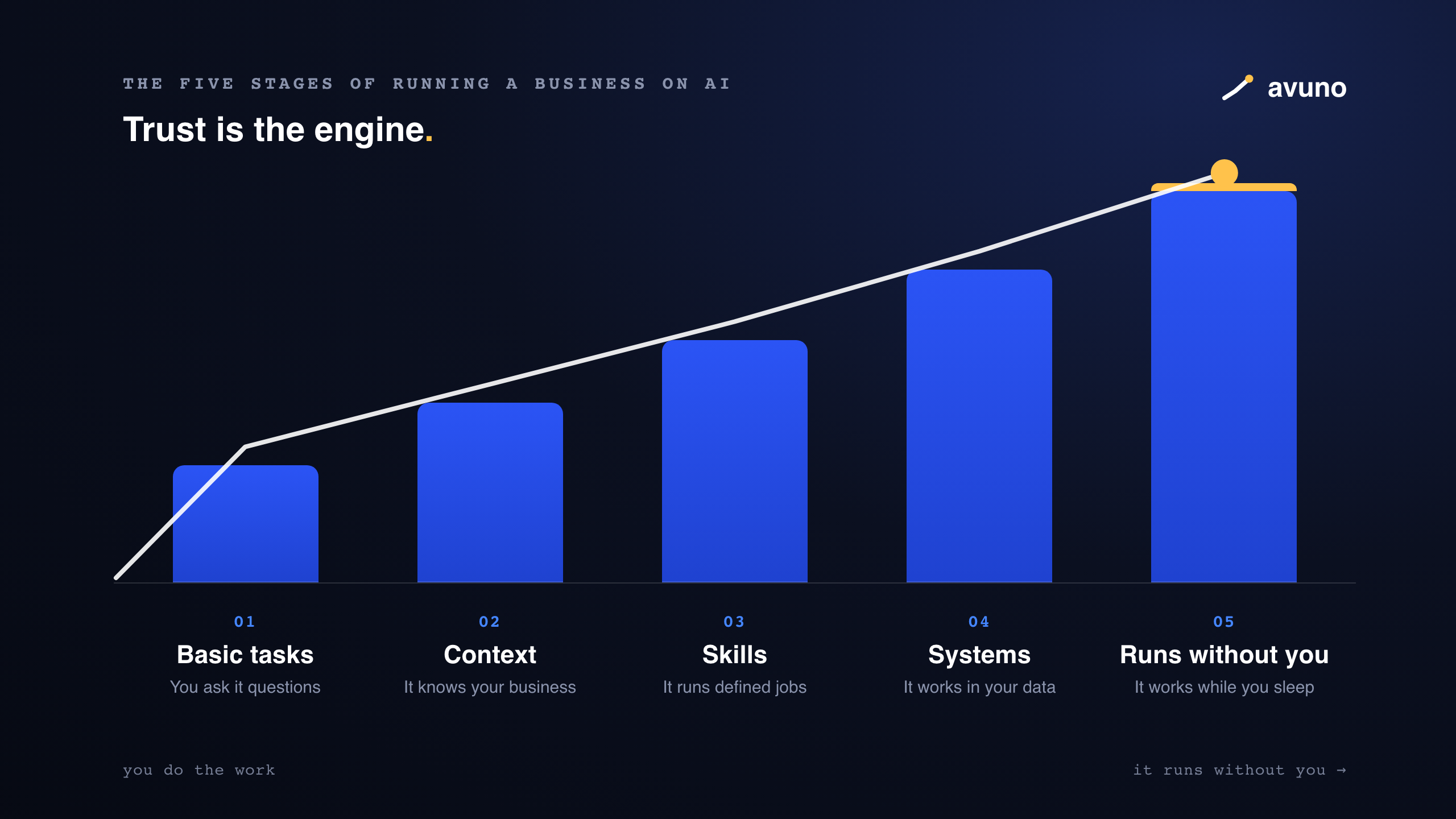
Most people track their AI progress by the tools they use. Which model, which app, which clever prompt. That’s the wrong axis. The thing that actually moves you forward is trust.
Mike Rhodes, who built the AI operating system a lot of us run our businesses on, reframed the whole journey this way recently, and it clicked for me. Every stage, you hand the machine a bit more work. It does the work well. So you trust it with more, and the payoff compounds. You move faster, reach the next stage, slow down to prove the new thing works, watch it work, and your confidence builds again. Trust is the engine. Tools are just what you happen to be holding.
He maps six stages. For a small business, five is enough to know exactly where you stand and what to do next. Here they are, with a Google Ads example at each one, because that’s the work I do every day.
Stage 1: Basic tasks
Everyone starts here. You open ChatGPT and throw a question at it. Write this email. Summarize this article. Explain this metric. It’s a smarter Google replacement, and that’s genuinely useful.
The tell that you’re at Stage 1: you re-explain your business every single time. The AI has no idea who you are, what you sell, or what you care about, so every session starts from zero. For a Google Ads operator, that looks like pasting the same background into every chat before you can ask a real question. It works, but it doesn’t stack. Nothing you teach it today is there tomorrow.
Stage 2: Context
Stage 2 is where you stop repeating yourself. You give the AI your context once and it stops needing the setup. Who you are. What you sell. Your margins. The rules you never break.
For a Google Ads operator, context is your account structure, your naming conventions, your target margins, the client’s do’s and don’ts, the campaigns you leave alone. Load that in once and every answer fits your account instead of a generic one. The advice stops being textbook and starts being yours. This is the first stage where the machine feels like it works for your business specifically.
The fastest way to build context, by the way, is voice. Talk through how your business runs and let the AI write the context files. Most owners never do this, which is exactly why most owners are stuck at Stage 1.
Stage 3: Skills
Context makes the AI smart about you. Skills make it do defined work the same way every time.
A skill is a packaged job. A product feed audit. A wasted-search-term sweep. A weekly change log. You build it once, and from then on the AI runs it the same way, to the same standard, without you re-explaining the steps. The machine stops improvising and starts executing.
This is where a lot of capable operators are right now. If you’ve installed a few skills and run them on real accounts, you’re here. The next move is the big one: building your own skills for the jobs you repeat most, instead of only using the ones you downloaded.
Stage 4: Systems (you are probably here)
A skill does one job. A system is what you get when you join skills, context, and your live data into one thing you run the business on.
The data is the unlock. Your account performance, your Merchant Center feed, your Google Sheets, all connected so the AI reads real numbers instead of what you paste in. In a tool like Claude Cowork these are called connections, and they turn a clever assistant into an operating system. Now the AI isn’t answering questions about your account. It’s working inside it.
The other half of a real system is being able to see it. You need a window into what the AI is doing, a dashboard, so you’re never trusting a black box. See the work, check the work, trust the work.
If you run Google Ads and you’ve been using AI seriously, this is almost certainly where you are. Skills joined to your data, with a way to watch it run. It’s a strong place to be. It’s also not the finish line.
Stage 5: Runs without you
Stage 5 is when the system does the work on its own and only involves you when it needs to.
It runs on a schedule, every morning before you’re up, or it reacts to an event: a feed breaks, a competitor drops a price, a campaign’s conversions fall off a cliff. The work happens. You don’t push the button.
The principle that makes this livable is management by exception. If everything ran clean, you hear nothing. The feed check passed, the search terms were swept, the report filed, silence. But the moment something is off, the system tells you fast: I expected five and only found three, what do you want to do? You stop being the operator and become the person the operator escalates to.
That’s the whole shift. At Stage 4 you run the system. At Stage 5 the system runs, and you get out of its way.
What’s past five
There’s a sixth stage Mike calls the frontier: the business that improves itself, where the system tunes its own workflows without you. It’s real, and it’s starting to happen. But it’s not where a small business needs to aim yet. Get to Stage 5 first. The frontier takes care of itself once the rest is in place.
How you actually move up a stage
You don’t leap. Every stage is earned by proving one more thing you can trust.
So the move is always small and specific. At Stage 2, load your business context once and feel the difference. At Stage 3, turn the job you do most by hand into a skill. At Stage 4, connect one real data source and build one dashboard to watch it. At Stage 5, take one job you already trust and let it run on a schedule, silently, with a tap on the shoulder only when something breaks.
Pick one. Prove it works. Your confidence, and your trust, does the rest.
Where Avuno fits
If you run Google Ads, this progression is exactly what I install for a living. Avuno Solo sets up the context, the skills, and the system on your real account, then walks you toward running it without living inside it. You skip the months of building it from scratch and start a stage or two ahead.
Wherever you are on the five stages, the next move is closer than it looks. Take a look at Avuno Solo and I’ll help you find it.

Andrey Kisselev
With over $15M in managed ad spend across a decade of hands-on work, he turns the same patterns he ran by hand into repeatable workflows you can run in Claude.